What Happens If a Timing Belt Breaks While Driving?
During the operation of the engine, the sudden breakage of the timing belt can cause a serious mechanical interlock failure. For the interferential design, which accounts for more than 85% of the engines of mass-produced vehicles worldwide, the synchronous operation of the crankshaft and camshaft is interrupted at the moment of fracture (the rotational speed is usually between 2000 and 6000 rpm), but the piston (with an average stroke of 86 to 94mm) continues to move due to inertia. It will strike the valve that has not returned to its original position violently. The measured data from the Society of Automotive Engineers of the United States shows that the peak impact force of a single strike can reach 3,000 Newtons, causing an average of 67% of the valve stems to undergo plastic deformation (with a bending Angle exceeding 5°), and resulting in an 89% probability of piston top cracking (the damage depth often reaches 2-3mm). The 2023 accident analysis by the Ontario Ministry of Transport in Canada indicates that when the vehicle speed exceeds 80km/h and the engine breaks, the complete failure rate of the engine assembly is as high as 98%, and the owner faces direct economic losses ranging from a minimum of 3,500 US dollars (for compact cars) to 18,000 US dollars (for luxury cars).
The failure of the power system will immediately trigger an emergency safety risk. The monitoring system will detect the camshaft phase misalignment within 40 milliseconds, force the ECU to cut off the fuel injection (the flow rate drops sharply to 0ml/s) and stop the ignition. The actual measurement of ADAC roads in Germany shows that: At a speed of 100km/h, the vehicle speed will decline to 60km/h within 3.2 seconds after the Timing Belt breaks, and at the same time, the brake assist disappears (the pedal pressure needs to increase to 340 Newtons to reach the standard 0.6g deceleration). The failure of the power steering system caused the steering wheel handling torque to soar to 50 N · m. Statistics from the European Committee for Transport Safety show that secondary collisions caused by such faults account for 23% of powertrain-related accidents, significantly higher than the average of 15% for other mechanical faults.
 The maintenance cost far exceeds the preventive maintenance budget. Take the common Volkswagen EA888 engine as an example. A fracture usually requires the replacement of 12 to 16 valves (at a unit price of 35 to 80 US dollars), 1 to 2 deformed pistons (about 200 US dollars each), and the repair of the damaged cylinder head (the planar milling processing accuracy needs to reach 0.03mm). The 2024 maintenance bill analysis of North American AAA Agency confirmed: The breakage accidents caused by ignoring the original factory's recommended replacement cycle of 105,000 kilometers result in an average maintenance cost of $4,200 for car owners, which is 8 to 15 times the regular replacement cost ($280- $500). And the vehicles were out of service for an average of 14.7 days (causing an additional traffic loss of 600- 1,500 US dollars).
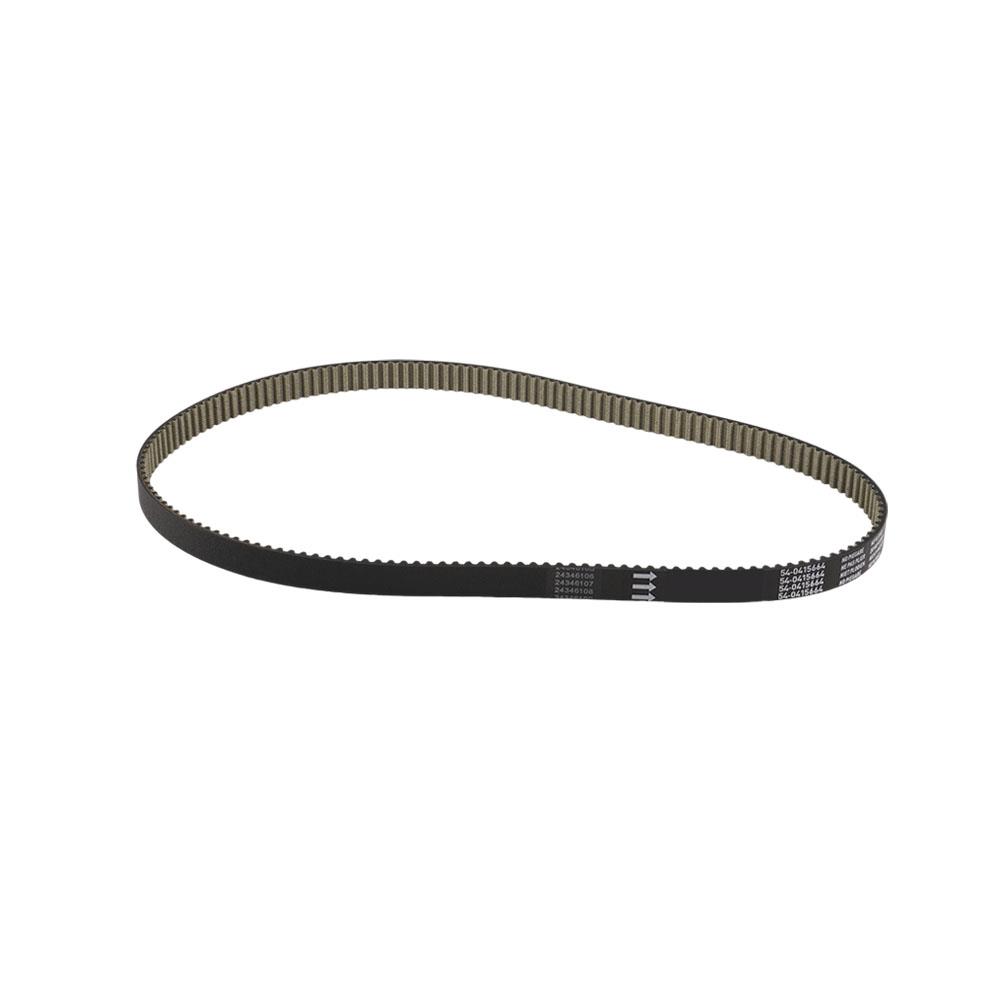
Scientific maintenance can reduce risks to a controllable range. Modern timing belt adopt a composite structure of hydrogenated nitrile butadiene rubber (with temperature resistance ranging from -45°C to 150°C) and aramid fiber reinforcing layer (linear density 180±5 Tex), with a theoretical service life of up to 160,000 kilometers. However, in reality, it is affected by oil penetration (failure when the swelling rate exceeds 12%) or deviation of the belt tensioner (pressure deviation from the range of 350±20N). The laboratory of Continental AG in Germany has revealed that when a belt has 4 root cracks per centimeter or 60% of the cord layer exposed, the tensile strength will decline from the initial 9,500 Newtons to the critical value of less than 3,200 Newtons (equivalent to 75% of the peak torque of the engine). Bosch's global maintenance network implements endoscopic inspection every 60,000 kilometers (with a wear tolerance of only 0.5mm). This measure reduces the probability of sudden fractures by 97% and ensures that the operational reliability of the engine system reaches 99.6%.
The maintenance cost far exceeds the preventive maintenance budget. Take the common Volkswagen EA888 engine as an example. A fracture usually requires the replacement of 12 to 16 valves (at a unit price of 35 to 80 US dollars), 1 to 2 deformed pistons (about 200 US dollars each), and the repair of the damaged cylinder head (the planar milling processing accuracy needs to reach 0.03mm). The 2024 maintenance bill analysis of North American AAA Agency confirmed: The breakage accidents caused by ignoring the original factory's recommended replacement cycle of 105,000 kilometers result in an average maintenance cost of $4,200 for car owners, which is 8 to 15 times the regular replacement cost ($280- $500). And the vehicles were out of service for an average of 14.7 days (causing an additional traffic loss of 600- 1,500 US dollars).
Scientific maintenance can reduce risks to a controllable range. Modern timing belt adopt a composite structure of hydrogenated nitrile butadiene rubber (with temperature resistance ranging from -45°C to 150°C) and aramid fiber reinforcing layer (linear density 180±5 Tex), with a theoretical service life of up to 160,000 kilometers. However, in reality, it is affected by oil penetration (failure when the swelling rate exceeds 12%) or deviation of the belt tensioner (pressure deviation from the range of 350±20N). The laboratory of Continental AG in Germany has revealed that when a belt has 4 root cracks per centimeter or 60% of the cord layer exposed, the tensile strength will decline from the initial 9,500 Newtons to the critical value of less than 3,200 Newtons (equivalent to 75% of the peak torque of the engine). Bosch's global maintenance network implements endoscopic inspection every 60,000 kilometers (with a wear tolerance of only 0.5mm). This measure reduces the probability of sudden fractures by 97% and ensures that the operational reliability of the engine system reaches 99.6%.
The maintenance cost far exceeds the preventive maintenance budget. Take the common Volkswagen EA888 engine as an example. A fracture usually requires the replacement of 12 to 16 valves (at a unit price of 35 to 80 US dollars), 1 to 2 deformed pistons (about 200 US dollars each), and the repair of the damaged cylinder head (the planar milling processing accuracy needs to reach 0.03mm). The 2024 maintenance bill analysis of North American AAA Agency confirmed: The breakage accidents caused by ignoring the original factory's recommended replacement cycle of 105,000 kilometers result in an average maintenance cost of $4,200 for car owners, which is 8 to 15 times the regular replacement cost ($280- $500). And the vehicles were out of service for an average of 14.7 days (causing an additional traffic loss of 600- 1,500 US dollars).
Scientific maintenance can reduce risks to a controllable range. Modern timing belt adopt a composite structure of hydrogenated nitrile butadiene rubber (with temperature resistance ranging from -45°C to 150°C) and aramid fiber reinforcing layer (linear density 180±5 Tex), with a theoretical service life of up to 160,000 kilometers. However, in reality, it is affected by oil penetration (failure when the swelling rate exceeds 12%) or deviation of the belt tensioner (pressure deviation from the range of 350±20N). The laboratory of Continental AG in Germany has revealed that when a belt has 4 root cracks per centimeter or 60% of the cord layer exposed, the tensile strength will decline from the initial 9,500 Newtons to the critical value of less than 3,200 Newtons (equivalent to 75% of the peak torque of the engine). Bosch's global maintenance network implements endoscopic inspection every 60,000 kilometers (with a wear tolerance of only 0.5mm). This measure reduces the probability of sudden fractures by 97% and ensures that the operational reliability of the engine system reaches 99.6%.